









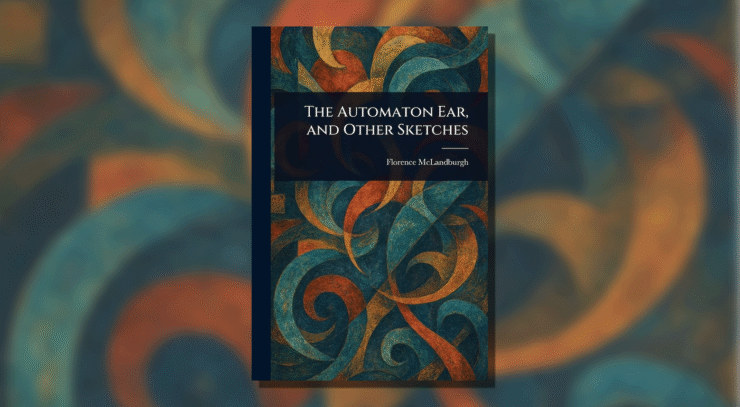
Welcome back to Reading the Weird, in which we get girl cooties all over weird fiction, cosmic horror, and Lovecraftiana—from its historical roots through its most recent branches. This week, we cover Florence McLandburgh’s “The Automaton Ear,” first published in Scribner’s Monthly in May 1873. Spoilers ahead!
An unnamed professor (henceforth ProfX) teaches at a college near London. One summer afternoon, he walks to a nearby woodland to read “bounded by no walls or ceiling.” He revels in the “changeful voice of the forest and the river,” barely aware of his book until he comes to this paragraph:
“As a particle of the atmosphere is never lost, so sound is never lost. A strain of music or a simple tone will vibrate in the air forever and ever, decreasing according to a fixed ratio. The diffusion of the agitation extends in all directions, like the waves in a pool, but the ear is unable to detect it beyond a certain point. It is well known that some individuals can distinguish sounds which to others under precisely similar circumstances are wholly lost. Thus the fault is not in the sound itself, but in our organ of hearing, and a tone once in existence is always in existence.”
It’s a passage he’s read before, but today he’s struck by the implications. Haven’t men created instruments that magnify the supposedly invisible? Could he, ProfX, do the same for sound?
The idea haunts him through the last days of classes. He decides to attempt this grand invention, to “labor quietly until it was perfected,” lest the world laugh. He stays on campus through vacation, studying acoustics and philosophy of sound. His only excursion’s to London, to purchase an ear-trumpet. To his delight, he finds his already sensitive ear can through it distinguish much more distant sounds. He modifies the ear-trumpet, but only diminishes sound. He needs a quieter laboratory.
An abandoned church tower has windows facing all four directions, and no one ever visits its ancient graveyard. ProfX enters through a coal chute. He transfers his tools and books, but success eludes him until he conceives a radical theory: He’ll use only the most sound-transmitting metals. When he first tries his new instrument, his hand becomes paralyzed, but the sensation passes and he hears only silence. By accident, he loses the trumpet’s ivory ear-piece—and discovers that with it gone and the metal applied directly to his ear, he hears a crash of discordant sound. Of course! A working instrument would so amplify present sounds to drown out all others!
ProfX broods over his failure. He begins to hate his students, his college, society as a whole. Eventually he modifies his instrument to control how near or far, new or old, the amplified sounds are. When he’s adjusted the controls finely enough to home in on particular time periods, he nerves himself for a second test and sets the controls as far back as they’ll go.
Success! He listens in on the flight of the Israelites from Egypt and the destruction of Pharaoh’s army. Then comes Miriam, singing her joy after the Red Sea passage. Later he’ll hear the song of a nightingale dead thousands of years, centuries-old banquet chatter, the famous performance of carillon virtuoso Mathias Vander Gheyn on July 1, 1745! But he also overhears more intimate passages, like a writer talking to his mother as he dies, his labored-over book just completed.
Having achieved his great work, ProfX loses any desire for fame: his only ambition is to remain its sole master. A strange fascination possesses him; with his ecstasies come agonies of paranoia. He resigns and takes lodgings near his laboratory. He hardly eats or sleeps in his hunger to listen to the “Ear.” But when friends inquire about his health, he looks into a mirror and sees the wasted, disheveled creature he’s become. Later he overhears one boy telling another “the professor ain’t just right in his head.” He fears it’s not only his body that’s suffered. Is he mad? Can he have deluded himself about the reality of his Ear?
Uncertainty tortures him into a desperate experiment. He lures an old deaf-and-mute woman, Mother Flinse, to his church. He will set the Ear to full power in present time. If this overcomes her deafness, he’ll have proven his success.
At length he persuades Mother Flinse to put the instrument to her ear. Instantly her face convulses, then seems to expand into radiant youth and beauty: After seventy years of silence, the Spirit of Sound holds her enchanted. ProfX is elated until she refuses to give up the Ear. She flees; he catches her; they wrestle. He strangles her to death, drags her to a churchyard tomb, and hides her body. He then returns the Ear to his tower, as tenderly as if it were a living thing. But when he listens, all he hears are Mother Flinse’s grating shrieks. She’s come to haunt him! He tries to destroy the Ear, jarring out a beetle, and realizes the “shrieks” were merely the insect’s frantic wing-beating.
Doubts relieved, ProfX sleeps peacefully. But in the morning, he sees Mother Flinse walking through the college gate. He runs to the churchyard tomb, and finds it undisturbed. He runs to the church, and finds his entry point nailed shut and cobweb-curtained.
Can the Ear have ever existed? Some “substance in [his] brain” seems to break up. It’s “the fetters of monomania” that bound him since the day he read that fatal paragraph.
He praises the Great Creator that he’s no murderer, that he’s “passed unharmed” through “black waves of insanity,” and his praise, though silent, is “intense as Miriam’s song by the sea.”
What’s Cyclopean: The description of Miriam’s song on the shore of the Sea of Reeds is gorgeous and awestruck: “Higher, sweeter, it seemed to break the fetters of mortality and tremble in sublime adoration before the Infinite. My breath stilled with awe. Was it a spirit-voice—one of the glittering host in the jasper city that had no need of the sun, neither of the moon to shine in it?’ …But no! The tone now floated out soft, sad, human. There was no sorrowful strain in that nightless land where the leaves of the trees were for the healing of the nations. The beautiful voice was of the earth and sin-stricken.”
The Degenerate Dutch: ProfX immediately recognizes “the rich, uncultivated soprano of the Southern slave making strange wild melody.” He’s also less than pleased by the adaptive uses to which his hearing aid might be put.
Madness Takes Its Toll: How do you know that you’re not insane? You can check if you’re hallucinating, of course, but that’s not the only kind of madness that might assail an obsessive researcher.
Anne’s Commentary
The first thing I wanted to know was where did it come from, that fateful paragraph ProfX quotes early on? He’s read it before, but only now, when it’s combined with robin-song, does he envision a practical application for its theories.
It turns out the paragraph is McLandburgh’s, paraphrasing a chapter from the 1837 Ninth Bridgewater Treatise of English mathematician and inventor Charles Babbage. In “On the Permanent Impression of Our Words and Actions on the Globe We Inhabit,” Babbage wrote:
“The pulsations of the air, once set in motion by the human voice, cease not to exist with the sounds to which they give rise… Their quickly attenuated force soon becomes inaudible to human ears…[but] the motions they have impressed on the particles of one portion of our atmosphere are communicated to constantly increasing others… The waves of air thus raised, perambulate the earth and ocean’s surface, and in less than twenty hours every atom of its atmosphere takes up the altered movement due to that infinitesimal portion of the primitive motion which has been conveyed to it through countless channels, and which must continue to influence its path throughout its future existence.”
Babbage later puts it metaphorically:
“The air itself is one vast library, on whose pages are forever written all that man has ever said or even whispered. There, in their mutable but unerring characters, mixed with the earliest, as well as the latest sighs of mortality, stand forever recorded, vows unredeemed, promises unfulfilled, perpetuating in the united movements of each particle, the testimony of man’s changeful will.”
Another possible inspiration was the work of German physician and physicist Hermann von Helmholtz. Among ProfX’s acoustics texts must have been von Helmholtz’s On the Sensations of Tone (1862), which delved into the mechanics of the human ear and its sensory limits—those same sensory limits ProfX is determined to overcome.
There’s an enduring but probably apocryphal story that Marconi entertained ideas similar to ProfX’s. In his Perfecting Sound Forever: An Aural History of Recorded Music (2009), Greg Milner recounts the tale:
“The story goes that, late in his life, Guglielmo Marconi had an epiphany. The godfather of radio technology decided that no sound ever dies. It just decays beyond the point that we can detect it with our ears. Any sound was forever recoverable, he believed, with the right device. His dream was to build one powerful enough to pick up Christ’s Sermon on the Mount.”
Milner adds some insight into the myth’s attraction:
“Its survival attests to a universal desire and anxiety. Our time on Earth is fleeting, the impressions we leave on it are ephemeral, but maybe there is a part of us that can outlast this dust-to-dust. Maybe our complete history is all around us. We just need to learn how to read it.”
Current science dismisses the idea that sound waves “live” forever. Eventually their organized vibrations yield to the random thermal movements of air molecules, leaving no “message” to retrieve, however sensitive one’s Ear.
“The Automaton Ear” is considered a foundational story in the “Acoustic Time Travel” subgenre. As I interpret the conclusion, ProfX never actually built a mechanical Ear of the World. Though we don’t know his academic specialty (I’d guess music history or theory), it’s not even fictionally credible that he’d have the ability or finances to engineer a working “instrument.” His drastic mood swings between crippling depression and manic optimism, even grandiosity, suggest he had a bipolar disorder with systematized delusions—that is, delusions that are complex, organized, and internally consistent. He imagines himself the creator of a miraculous device which only he has the right to employ.
As an anti-fan of Unreliable Narrators Eventually Revealed to Be Insane, I was disappointed by McLandburgh’s ending. I found the Reveal too abrupt, though she tries to prepare for it by providing ProfX with late-in-story doubts about his sanity.
All ProfX needs to rend the “fetters of monomania” and “pass unharmed” through the “black waves of insanity” is to see that the person he murdered with little remorse is still walking about. “Suddenly” all right, the scales drop from his eyes, and he can see that he never disturbed a tomb to hide his never-victimized victim and that no one has passed through the securely nailed and cobwebbed church entrance for years. So, praise the “Great Creator,” ProfX is a cured man, and it was all a fever-dream, both the ecstasies and the horrors.
The story’s last line is problematic. That song of Miriam ProfX compares to his own praise of the Creator? It could be Miriam’s song as he imagined it in his delusion. Or—
Could McLandburgh be hinting that ProfX did hear Miriam’s song, because he did create a connection between himself and eternal sound waves?
Not sure I have the appetite or credulity to eat this cake two ways. It is a pretty last sentence, though.
Ruthanna’s Commentary
I encountered “The Automaton Ear” through Steve Jankowski’s media stories project, at a University of Amsterdam event on speculative literature. The weird gets everywhere. Jankowski suggests that we’ve always been anxious about the tools that mediate our experiences —there’s a throughline from the obsessive scientists of Victorian literature to algorithmic horror.
Here we have the 19th century variety, a sort of precursor to “From Beyond” and “Unseen — Unfeared”. But the perceptions opened to ProfX aren’t extradimensional or demonic. They’re ordinary sounds, made extraordinary by their reclamation from the past. They’re no less dangerous for that: having the whole of history to choose from makes ephemeral music seem mere noise. Why care for the local choir when Miriam’s song of freedom echoes eternally?
As it happens, it’s no longer 1873, and I’m sitting beside a device on which I can play an extraordinary range of preserved music. The voices of the dead, the best symphonic orchestration, even recreations of neolithic music, are available at the tap of a screen. To imagine this available to only one person… there’s true horror.
Fortunately MP3s haven’t despoiled my pleasure in live music, but no word on how I’d deal with the ability to listen to a full 40-part chorus performing Spem In Alium any time I wanted, not collapsed into mere stereo.
ProfX isn’t merely Exhibit A for the idea that rock music would drive medieval peasants mad. His monomania has layers. First there’s the initial surge of invention: the desire to hear everything supplants appreciation for the existing soundscape. Attention is limited, and you can only hear so much at a time. Why assume that the not-quite-lost past is so much more desirable than the birdsong above your head? It’s inaccessibility that makes the grass seem so green.
Then once the horn is made, obsessive jealousy kicks in. Like so many, ProfX just wants to scroll on his device, ignoring his health and the world beyond his screen trumpet. But because he has the only screen trumpet, he’s terrified of sharing. Or maybe the reason is deeper and more amorphous: some sense of guilt over pulling aside a veil, some fear that others would either share or disdain his obsession.
But then, if you’re experiencing That Which Man Wasn’t Meant To Know solo, how do you know your experiences are real at all? Thus the fourth layer of monomania: the need to prove the trumpet real without sharing it. So he enlists Mother Flinse, my favorite character in the story, in a symphony of ableist exploitation that shows how far he’s fallen. But she’s great anyway: smart despite 1800s attitude toward the deaf and mute, understandably delighted by the sudden appearance of adaptive technology, and not particularly saintly in how she reacts. Its obsessive power isn’t unique to ProfX.
Assuming, of course, that we do more than glimpse her at all. The murder is hallucinated (unless the events of the next day are hallucinated, hmmm); is the entire interaction with her also a figment of ProfX’s imagination? And if so, does the vision legitimately push him past the “fetters of monomania,” or is that just another layer?
We close, as we opened, with in-the-moment birdsong. Unlike many obsessive professors of the weird, this one has some appreciation for everyday perception—when he can be forced away from doomscrolling.
Join us next week as Three-Persons also tries to figure out what’s real in Chapters 15-16 of Stephen Graham Jones’ The Buffalo Hunter Hunter.
